Wednesday, November 12, 2008

Water Access and Sanitation

The reason I chose this topic is because of the group I was invited to on Facebook - I know we've all gotten those "I'll donate $___ to ___ if 23452478657345 people join!" invites, but this one looked a little more promising: The H20 Project (you might have to log in to see it, but that shouldn't be a problem for anyone) suggests that you give up every beverage but water for two weeks and then donate the money you save to the H20 Project. This actually makes a lot of sense, it's a pretty easy way to donate, and it's healthy! I already drink water all day anyway, but if I didn't buy my gallon of milk or coffee for two weeks, that would easily be $10.

It's so depressing to think that the grocery store I work in has a full aisle of soft drinks, another of juice and milk, and two aisles of alcohol (yep... that's a college town for you), and my job at the coffeeshop is just to make drinks, while people in other parts of the world can't even get a class of clean water every day.
Living Water International has a lot of information on their site, but here are some clips about access to water, lack of sanitation, and social effects:

"Water, the stuff of life and a basic human right, is at the heart of a daily crisis faced by more
than one billion of the world's most vulnerable people.
Nearly half of all people in developing countries are suffering from water-related health problems. The annual number of deaths from water-related diseases is six times greater than the number of deaths from armed violence.

One-third of all deaths in developing nations are children under the age of five. Some 1.8 million of these children die each year as a direct result of chronic diarrhea—that's 4,900 every day. That is directly related to the water they drink.

Almost two-thirds of people who lack access to clean water survive on less than two dollars a day, and one-third live on less than one dollar a day. Some might lack water because they are poor, others might be poor because they lack water, but the statistics show a two-way relationship between poverty and water deprivation.

In Sub-Saharan Africa, the money lost from missed work opportunities due to water-related illnesses exceeds the amount of aid and debt relief to the region.

In Africa and Asia women are generally responsible for collecting water for their families. On average, in rural Africa, women spend 26% of their time collecting water, which often means having to walk five miles or more to the nearest water source. In the dry season, when water becomes more scarce, this distance can double and it can take hours just to fill up one container as the water slowly filters through the ground."
Living Water International's site has many other news stories and information, there are several other links on the Introduction page and a seperate page for their mission statement and history.

Overall, I think this organization looks incredible. I've heard of the Living Water group before (organizations like this get a lot of spotlight time over in the College of Health and Human Services), but this is the first time I've been able to think about it and know some of the cultural context for its purpose. It is important to remember that every time we get depressed in class because of what we read, there are already groups like this that exist to help, there are people in the world who care.

(I found this last map from Columbia University's site, if you ever want a map of something really random and hard to find, they might have it)

Monday, November 10, 2008

The Bleeding of the Stone

I enjoyed this book for how different it seemed to be from anything else we've read so far; but after finishing it and thinking for a minute about what to write about, I realized it's not as different at what I thought.


The first thing that stood out to me after reading this book was how alone Asouf seemed to be in comparison to the extended families that have been the central characters of other books. Asouf is a "desert man," but he has plenty of memories of his family and comes in contact with the outside world a significant amount. So he is alone, yes; but any of the characters in other books were alone, even if not quite so literally- people like Lomba were alone in their beliefs or their practices.

Another thing about Asouf that stood out to me was his direct contrast to Cain - Asouf does not eat any meat, but Cain literally lives for meat (and how disgusting was his character? Ew.)

And of course, I went off to Wikipedia to find out just what was so special about the waddan, or the moufflon. Apparantly "the mouflon is thought to be one of the two ancestors for all modern domestic sheep breeds," and it's subspecies are all vulnerable or extinct (I suppose we have people like Cain to thank for that). I couldn't find anything about the religious significance of these sheep, but the connection between these animals and Asouf is an interesting literary device.

Wednesday, November 5, 2008

Student Demonstrations

Sometimes when dealing with anything related to Africa, I feel extremely overwhelmed because of how big Africa is geographically, how many people are involved, and how many conflicts that seem to be impossible to keep straight. So, I tried to narrow down some information on student demonstrations in Nigeria, but I also found a few handy websites: Africa Action is a U.S.-based group that fights for political action, policy change, and international awareness for Africa. I found a few pages about Nigeria from their homepage, including a timeline of Nigerian political history. The "Abacha years" section starting in 1993 seem to be particularly relevant to the events in Waiting for an Angel.


Part of Abacha's regime included banning student and faculty unions, which were legally recognized groups. The military violence against these student groups sounds like it would be something like our College Democrats and Republicans groups being attacked for peaceful demonstrations, like the sidewalk chalk or encouraging voter participation. Even though Nigeria is currently under a civilian government for the longest stretch of time since the beginning of its independence, there are even still instances of student leaders being arrested for false charges.

Monday, November 3, 2008

Nigerian Politcal Prisoners

In Waiting for Angel, Lomba is held in a prison for a "crime" he did not commit, the "crime" of organizing a demonstration, when he says he was only a reporter covering the demonstration. I wanted to understand a little bit more about Nigerian political prisoners, so I turned to Google, which is always ready to answer my questions.

First of all, Wikipedia says Nigeria is a federal presidential representative democratic republic - ok, if you have that many words in the name of your government, I'm pretty sure something is bound to go wrong if you can't even decide how to narrow it down to a word or two.
A series of articles from the LA Times followed the promised release of political prisoners from Nigerian jails and detention centers in 1998 and 1999. Nigeria lost its place in the British Commonwealth after the execution of Ken Saro-Wiwa, whom we just read about.
Chinedu Karl E. Uchegbu, of the Institute of Human Rights and Humanitarian Law in the Niger River delta town of Port Harcourt, noted that Nigeria’s government, by releasing all the remaining political prisoners, would simply be fulfilling its obligations. “These are people who were actually not meant to be in jail anyway,” Uchegbu said.
One of the prisoners to be released was the man who had fought against Nigeria's tyranny and apparantly won the 1993 presidential elections, Moshood Abiola. In order to be released, he agreed to relinquish his claim to the presidency and join Nigeria’s latest military efforts in working toward a peaceful transition to democracy. However, Abiola died of a heart attack in the summer of 1998 before he was released, and many worried his absence from the Nigerian government would raise tensions and human rights would be violated again without the prominent activist.

Riots did break out when news of Abiola's death was released, and stalled negotations and business surrounding the formation of the democratic government. The government did release more politcal prisoners, but it was seen as merely a gesture to anti-government militants who continued to riot over Abiola's death, which they viewed as suspicious, and the lack of progress made in the transition of the government.

I think all of this is relevant, as tomorrow is election day. Events like these in Nigeria and in other parts of the world make me feel very grateful for having a stable political system, and knowing that I can go vote (even if I do have to stand in a line all afternoon) and not worry about myself or whoever I vote for being jailed because of it.

Thursday, October 30, 2008

Oil!

Reading the articles from National Geographic and Slate and talking today in class about the scramble for this particular African resource made me think of Oil! by Upton Sinclair and that recent, really boring yet award-winning movie (that I've forgotten the name of) that was based on the book. The plots in these take place in California or Texas (I think the book and the movie differ a lot... surprise.), and obviously do not have the same large-scale effects as the events in Africa. It's interesting, to me, at least, that the discovery of oil can connect different people and different parts of the world, whether through trade or just the common effects on the surroundings, social and ecological.

Something that stood out to me in the article from Slate is the settlement town, Atan, across the street from the Kome drilling base for ExxonMobile. It seems to me that the presence of the impoverished, dirty town of Africans hopeful for a job in their own country directly next to the big, shiny, base of foreigners is an example of what all of Africa has become. A report on oil drilling fields in Chad and Cameroon even mentions Atan, but only to reassure that the population has not increased.

A blog titled "Only in Africa" brings up a lot of good points, and references John Ghazvinian's Untapped. It's worth a look if you have a few minutes.

This map also makes me think of what was mentioned in class a few times, about all roads leading to the coast instead of internal African cities. Instead the oil pipe going north or east to cities who could refine it an use it, guess where it goes? Southwest, to the coast.

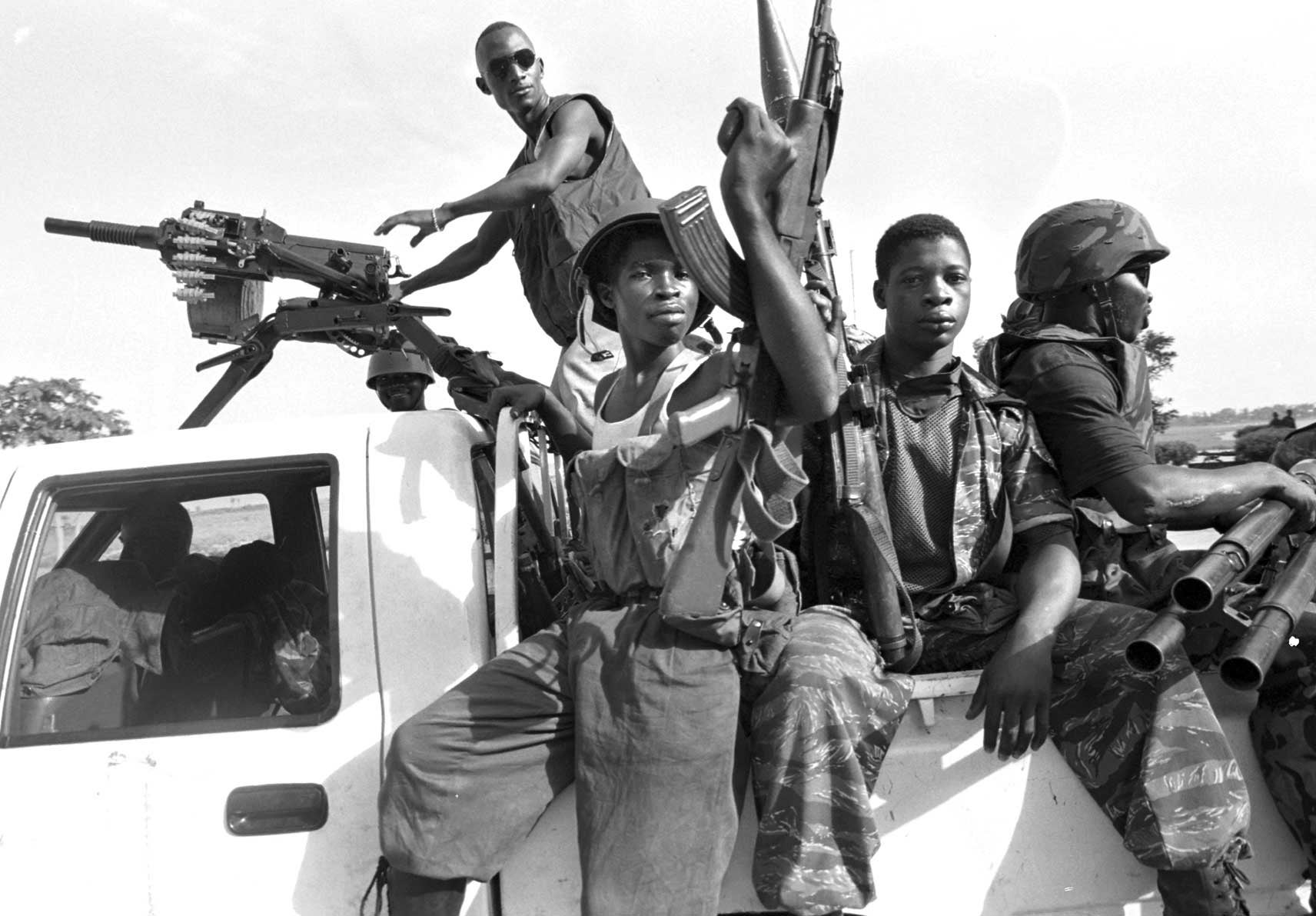
War In Sierra Leone/Africa


On April 27, 1961, Sierra Leone gained its independence from Britain. Between then and October 1990, a one-party Constitution was in place and there were many military coups, some successful and some not, to overthrow the government. In October 1990, a multi-party system was approved by Parliament and subsequent events began to occur that we saw in Ancestor Stones.
"A military intelligence source who has extensive experience in West Africa described the regional warriors as follows: 'These guys form part of a regional militia I call the insurgent diaspora. They float in and out of wars and operate as they wish. They have no one to tell them where, when and how to behave. They’re been incorporated into militias and armies all over the place – Sierra Leone, Côte d’Ivoire – and are really the most dangerous tool that any government or rebel army can have.' "

The Revolutionary United Front (RUF) was created with help from Liberia, a neighboring country involved in its own civil war. The main reasons war finally erupted was because of government corruption and the corruption in the diamond business; yet, the leaders of the Liberian forces who aided the RUF were paid in diamonds. At first the RUF was popular in Sierra Leone, as the people thought these rebels would stop the government corruption, however, due to the atrocities we saw in Ancestor Stones and Blood Diamond, the RUF quickly became hated and feared. From 1991 to 2002, the RUF continued to fight for control. After the RUF gained control of the diamond mines, it focused on protecting this economic resource and while the economy of Sierra Leone fell apart, the Armed Forces Revolutionary Council, another group of rebel soldiers, allied itself with the RUF to protect the economic and political power gained from the diamond trade. The RUF was finally defeated as a military force by an invasion led by Nigerian troops that reinstated Sierra Leone's president, Ahmad Tejan Kabbah.

After RUF troops were evicted from the capital, it became a political party for the 2002 elections. It won 2.2% of the popular vote and no Parliamentary seats. The party then merged with the All Peoples Congress, which is one of the two major politcal parties in Sierra Leone (the other is the Sierra Leone People's Party).


Wednesday, October 22, 2008

Ancestor Stones

For the most part, I really enjoyed Ancestor Stones. This is a book I can actually imagine myself reading outside of class, something I could enjoy while sitting on my couch with some hot chocolate instead of my desk with a pen and notebook handy.

One quote that really jumped out to me and almost seemed to sum up each woman's journey was in Abie's section at the very end:

"I was no longer a stranger. I knew just where into all of this I fitted. Because in this small world [the village], everybody had a place, meaning they all knew how they came to be here. A story of which every detail was cherished. And I had mine."

In my previous entry, I wondered if I would every see a happily-ever-after in any of the stories, because each woman had a dud for a husband, or left her husband, or had too many husbands, or did something or had something happen that caused her to be unhappy. But I think the above quote could be applied anywhere in the novel: literally in the village, which is what Abie was talking about in context; but also where each woman eventually found the end of her story, and in the family structure of this book, that is, the three or four generations that this novel chronicles.


My intent for this blog was to write about the dynamics of the women in the village, but when I went to trusty Google to find "Rofathane," I couldn't find anything about this village. I did, however, find an article from Aminatta Forna's website about Rogbonko, the village her grandfather founded and where he planted coffee foundations and grew rice - sound familiar? It is how Asana's story starts, with her father planting coffee beans in their "oasis in the forest," named Rofathane.

So, since I discovered Rofathane is apparantly based on Rogbonko, I took a look at the pictures on Forna's page about Rogbonko, which are definitely worth a look because it makes the stories in Ancestor Stones a little more real, to know that the village of Rofathane and the people who lived there are based in fact.

So, to wrap up my tangent and back to African women and Ancestor Stones: ultimately, it is important to remember that Rofathane and the women in Abie's family have their own niches and their own history that we may think we might not understand, but with the help of books like Ancestor Stones, we can.